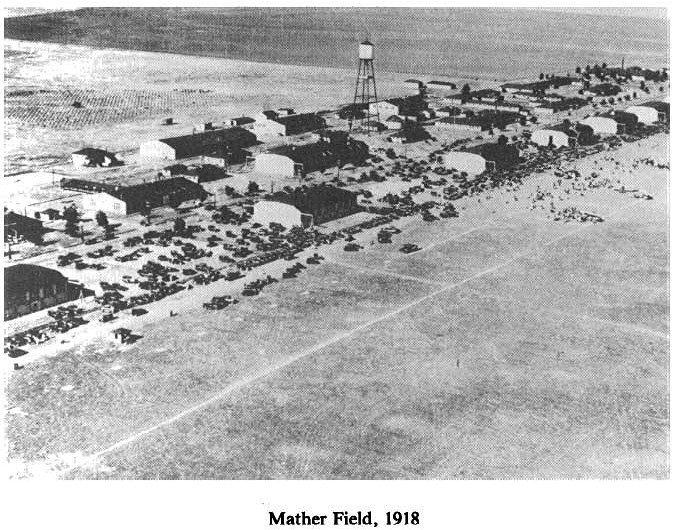
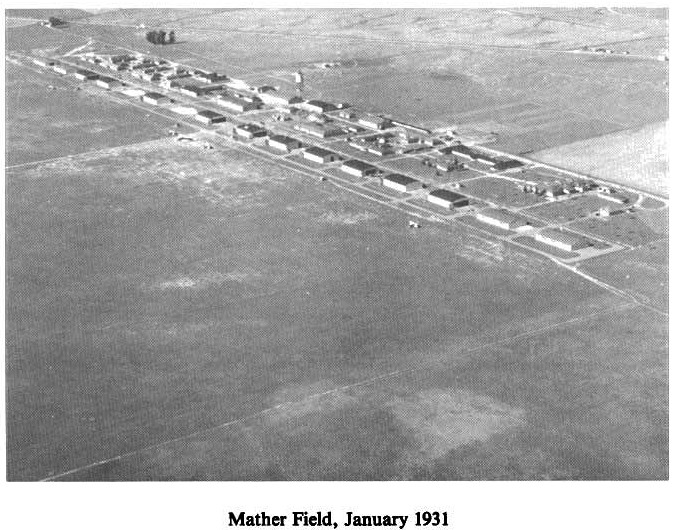
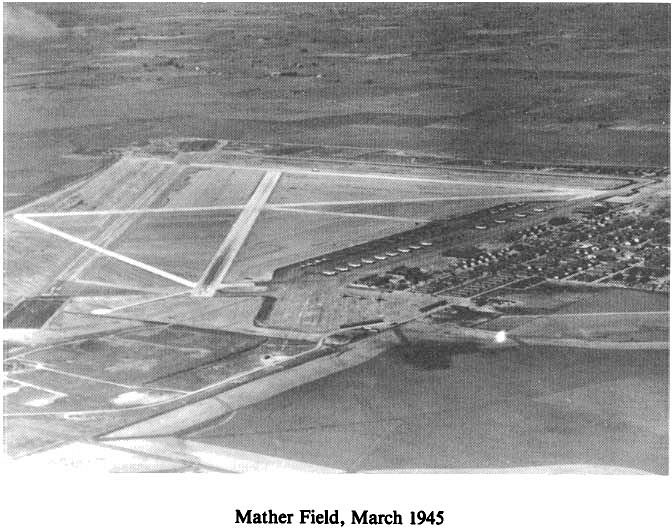
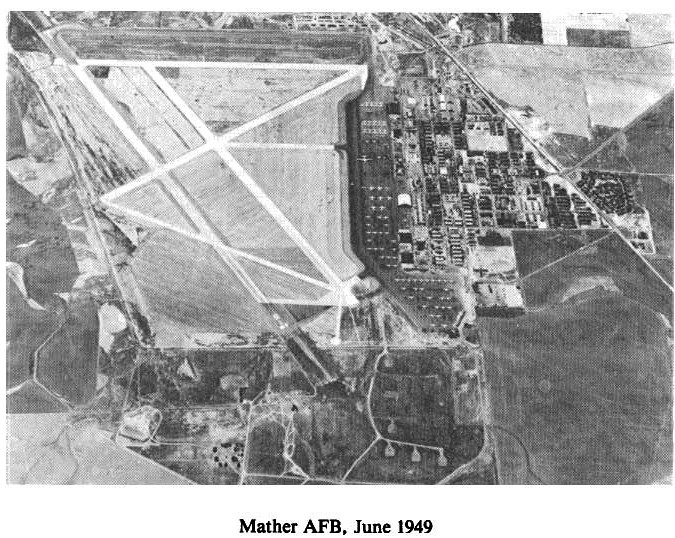
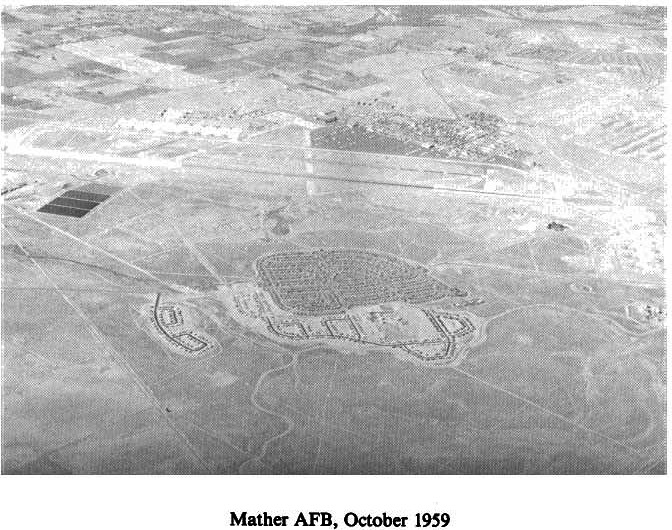
Mather Air Force Base, California
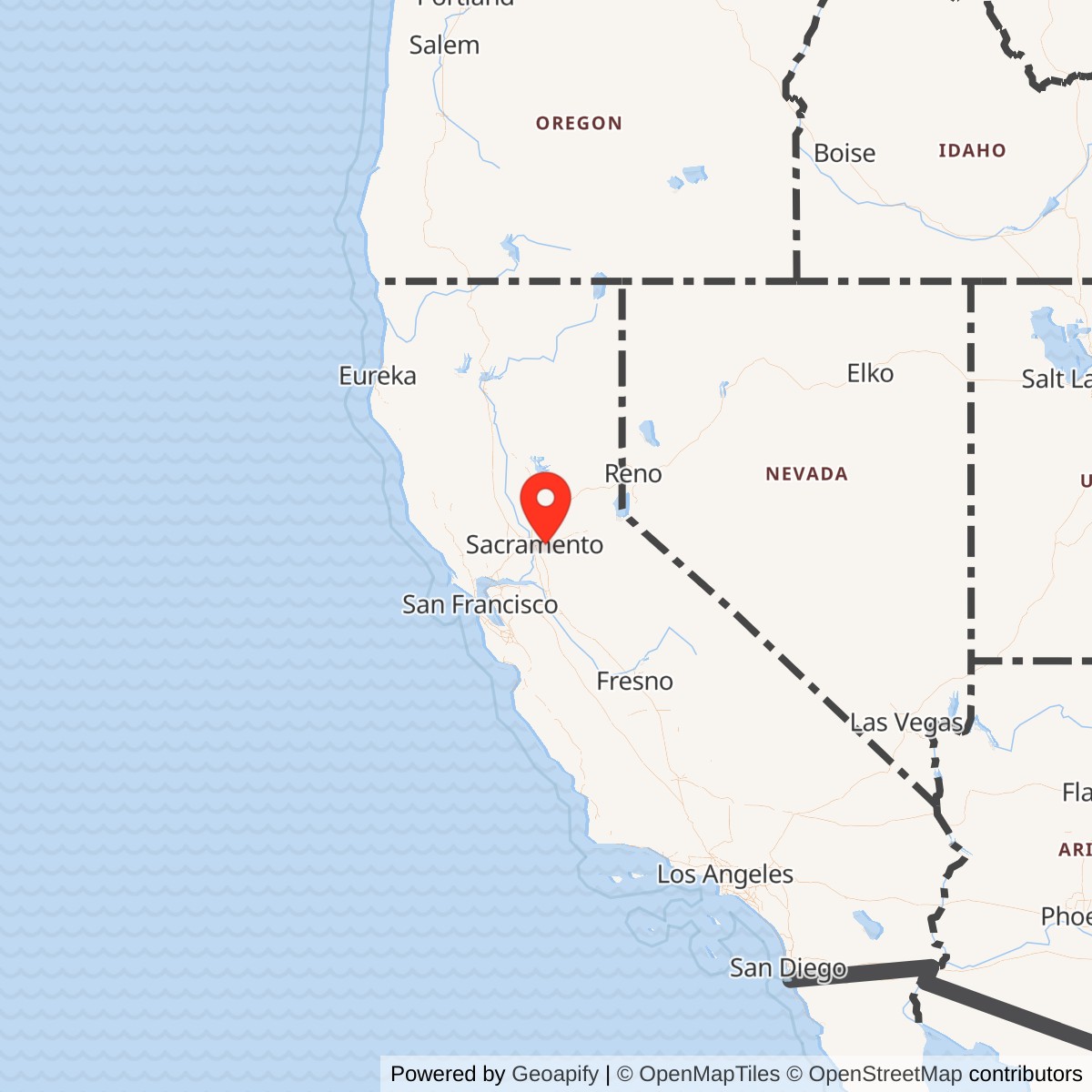
Location: Located 12 miles SE of Sacramento, CA.
Longitude: -121.2977
Origin of current name: Named in honor of 2d Lt Carl Spencer Mather (1894-1918). Lieutenant Mather learned to fly in 1915 and was killed on 30 Jan 1918 while on a training flight near Ellington Field, TX, when his JN-4D collided with another aircraft.
Date current name was assigned to base: 13 Jan 1948
Previous Names: Mather Field, 2 May 1918
Date Established: 21 Feb 1918
Date Occupied: 30 Apr 1918
Construction Began: 15 Mar 1918
Changes in Capability: Original construction completed 15 Jun 1918; training activities ceased 8 Jan 1919; field subsequently used by aerial forestry patrol; field area increased from 872 to 4,418 acres Jun 1941; navigation school started Aug 1941; major facility construction project completed 16 Mar 1942; B-25 transition 1943; Port of Embarkation for Pacific 1944-1945; USAF Bombardment and Flight Engineer Schools opened Mar 1946; 750-unit Wherry housing project completed fall 1951; expansion project to accommodate, in a tenant status, SAC B-52 operations 1956-1957; additional construction, chiefly housing and concrete operational areas, completed 1961 and 1962; GAM-77A missiles activated 1962; electronic warfare officer training transferred from Keesler AFB, MS, 1962-1963; composite medical facility completed late 1970; SRAM weapons system operational 1 Oct 1975; weapons system security upgrade project completed Feb 1980.
Major Changes in Status: Base served only for aerial forest patrol, beginning 8 Jan 1919; inactive status, 22 Jun 1922; field closed, 12 May 1923; active status, 1 Apr 1930; inactive status, 1 Nov 1932; a sub-post of Presidio U.S. Army post, San Francisco, unk-13 May 1935; designated a sub-post of Hamilton Field, 13 May 1935; designated a sub-post of Stockton Field, 21 Feb 1941; established as a separate post and activated, 13 May 1941.
Changes by the 1991 Base Closure Commission to the 1988 Base Closure Commission recommendations included relocating the 940th Air Refueling Group to McClellan AFB, California, leaving the 323rd Hying Training Wing Hospital open as an annex to McClellan AFB, California, and relocating the Undergraduate Navigator Training mission to Randolph AFB, Texas. The 1993 Base Closure Commission then changed the 1991 Commission's directed beddown of the 940th Air Refueling Group to Beale AFB, California vice McClellan AFB, California. Due to the closure of Mather AFB, the 940th Air Refueling Group was directed to temporarily relocate to McClellan AFB, awaiting permanent beddown at Beale AFB.
Mather AFB is located on 5,798 acres of land approximately 12 miles east of downtown Sacramento, California. The base is situated approximately midway between San Francisco and Lake Tahoe and is directly adjacent to the community of Rancho Cordova.
The construction and activation of Mather AFB began in March 1918. After a few years as a flight training school, the base was inactivated in June 1922. The base was reactivated for a short period between March 1930 and November 1932 but was not involved in continuous military action again until World War II. The base was reactivated in 1941 and was rebuilt as a school for pilot and navigator training. Mather AFB officially resumed its training mission in December 1945, becoming the first school for navigator-bombardiers.
An important milestone in Mather's history was established in 1958 when the Strategic Air Command (SAC} assigned the 4134th Strategic Wing to Mather as a tenant organization. In February 1963 the 320th Bombardment Wing was activated and replaced the 4134th Strategic Wing. In April 1973, the 323rd Flying Training Wing was activated and assumed the navigator training mission, replacing the 3535th Navigator Training Wing. The change in organization marked the beginning of significant changes in the concept of undergraduate navigator training.
In July 1976, undergraduate navigator training for the U.S. Navy and U.S. Coast Guard, and support of the Marine Aerial Navigation School was assumed by the 323rd Flying Training Wing, which became the only navigation training wing to provide undergraduate and advanced training to all services under the Department of Defense,
The 323rd Flying Training wing of the Air Training Command remains the current host unit. The primary mission is to "qualify non-rated officers as navigators; and provide the navigator with the technical training, experience, guidance and motivation required to operate the advanced navigation, bombing, missile, and electronic warfare systems used by the United States Armed Forces. There are 44 aircraft currently assigned to the training program. These include 31 1-37B aircraft and 13 T-43A aircraft. The total DoD work force on Mather AFB numbers 6,724, of whom 3,240 are military airmen; 1,641 are military officers; and 1,843 are civilians.
Installation History
In October 1917, the Sacramento Chamber of Commerce launched a campaign for Sacramento to be chosen as a site for the training of Army aviators. The land was obtained in February 1918 by the Chamber of Commerce and presented to the United States Government by the community of Sacramento. Construction of the base began the following month. On May 2, 1918, the installation was named in memory of Second Lieutenant Carl Spencer Mather, who had been killed in an air training crash near Ellington Field, Texas, in January 1918.The first aviators arrived at Mather Field on June 8, 1918, and the first flight from the base was made 4 days later. Flight training was discontinued on January 8, 1919. In the months that followed, activities were reduced to mostly caretaker duties with occasional air patrols by the forestry service. In June 1922, the field was inactivated. Mather Field was reopened cs March 3, 1930 in preparation for the "War Games" the Air Corps held the following month. On November 1, 1932, Mather Field was again inactivated.
Reactivated in 1941, Mather Field was rebuilt as a school for pilot and navigator training. In 1944, the base became a port of aerial embarkation--and later a port of debarkation, under the Air Transport Command, and many additional facilities were built. Mather Field resumed its training mission in December 1945, becoming the first school for navigator-bombardiers.
An important milestone in Mather's history was established in 1958 when Strategic Air Command (SAC) activated and assigned the 4134th Strategic Wing to Mather as a tenant organization. More than $20,000,000 was spent to construct additional buildings and other facilities for the SAC operation. On February 1, 1963, the 320th Bombardment Wing was activated and assigned to Mather, replacing the 4134th Strategic Wing, which was inactivated.
In 1961, electronic warfare officer training was transferred to Mather from Keesler AFB, Mississippi. By August 1961, electronic warfare upgrade, refresher, and familiarization training courses were being taught.
It was decided in 1964 that undergraduate navigator training would be relocated to Mather from James Connally AFB, Texas. This action unified all related navigator training into one composite mission under the 3535th Navigator Training Wing.
On April 1, 1973, the 3535th Navigator Training Wing was inactivated and the navigator training mission was assumed by the 323rd Flying Training Wing, which was activated the same day. This change in organization marked the beginning of significant changes in the concept of undergraduate navigator training.
Under the new course concept called "Undergraduate Navigator Training System," jet aircraft were used for the first time in undergraduate navigator training. Additionally, the new course incorporated a complex of highly sophisticated simulators as part of the improved instruction.
After more than 20 years of operation, the use of the Convair T-29 "Flying Classroom" for navigator training was phased out by March 1975. The phase-out of the T-29 began with the arrival of the new jet-powered Boeing T-43 Airborne Navigator Trainer aircraft in September 1973. A year later, the Cessna T-37 jet trainer was introduced to the navigation training program.
Undergraduate navigator training for the U.S. Navy and U.S. Coast Guard, and support of the Marine Aerial Navigation School--which relocated to Mather from Corpus Christi, Texas--was assumed by the 323rd Flying Training Wing in July 1976. With the establishment of the inter-service undergraduate navigator training program, the 323rd Flying Training Wing became the only navigation training wing to provide undergraduate and advanced navigation training to all services under the Department of Defense.
A major revision to the undergraduate navigator training program was implemented in October 1978. The revised program reduced the number of training days for the basic undergraduate navigator course and initiated two additional courses: Advanced Navigation and Tactical Navigation. This was the most extensive revision of the undergraduate navigator training program since the introduction of the T-43 Airborne Navigator Trainer aircraft.
Primary Mission
The 323rd Flying Training Wing of the Air Training Command remained host unit at Mather AFB. The primary mission was to "qualify non-rated officers as navigators; and provide the navigator with the technical training experience, guidance and motivation required to operate the advanced navigation, bombing, missile, and electronic warfare systems used by the United States Armed Forces."The major tenants at Mather AFB and their missions are summarized below:
320th Bombardment Wing (SAC)
The mission of the 320th Bombardment Wing is to maintain the capability to conduct long-range bombardment operations using assigned weapons and to sustain the capability to engage in effective air refueling operations. Performance of the mission involves effective utilization of assigned bombers, tankers, and air-to-ground missiles in conducting readiness training while maintaining a portion of the Wing's force on immediate reaction ground alert.
Detachment 7, 24th Weather Squadron (MAC)
Det 7, 24WS provides meteorological support to all units assigned to Mather AFB as well as to transient aircrews.
2034th Communications Squadron (AFCS)
The Squadron provides Mather AFB and its tenants with communications and air traffic control services.
3506th USAF Recruiting Group (ATC)
The 3506th is currently responsible for recruiting Air Force personnel from 13 western states, including Alaska, Hawaii, Guam and the Philippines, plus the western tip of Texas, Kansas, and Nebraska.
Det 515, 3751st Field Training Squadron {ATC)
This Detachment is responsible for onsite aircraft maintenance training and OJT advisory service at Mather AFB. The Detachment trains USAF and civilian personnel in the aircrew and maintenance support areas on the T-43, T-37, B-52, KC-135, and on-the-job training.
AFOSI Detachment 1904
Det 1904 is a detachment of AFOSI District 19, Travis AFB, California. Upon request, AFOSI provides professional investigative services to commanders of all Air Force activities in the criminal, fraud, and counterintelligence areas.
Det 3, 3314th Management Engineering Squadron (ATC)
This Squadron provides management advisory services to base operating officials, develops manpower standards and evaluates applicability of standard to base functions, and prepares local mission, manpower management, and organization directives in accordance with command policy.
Det 448, Area Audit Office, Air Force Audit Agency
The mission of this Detachment is to provide base officials with an independent, objective, and constructive evaluation of the effectiveness and efficiency with which managerial responsibilities (including financial, operational, and support activities) are carried out.
USAF Civil Air Patrol Pacific Liaison Region (AU)
Duties include supervising liaison offices in California, Nevada, Oregon, Washington, Alaska, and Hawaii and advising and assisting the Civil Air Patrol Region Commander in the management of resources and development of training.
Army Aviation Support Facility (ARNG)
Duties include providing centralized control and proper use and operation of the aviation assets assigned to northern California. To accomplish this mission, they are authorized 55 full-time administrative and maintenance technicians. In addition, approximately 70 assigned part-time pilots fly support missions as part of their training requirements.
USAF Judiciary Area Defense Counsel
The Counsel performs as defense counsel in courts-martial proceedings, Article 32 investigations, administrative separation actions, and interrogation situations.
HQ 940th Air Refueling Group (AFRES)
In peacetime, the mission of the 940th AREFG is to develop and maintain the operational capability to conduct strategic warfare tasking identified in Strategic Air Command (SAC) Emergency War Orders and supporting OPLANS.In wartime and periods of post mobilization, the 940th AREFG will be assigned to the Strategic Air Command and will execute those missions and tasking as directed by Hq SAC.
Federal Aviation Administration (FAA)
The Airway Facilities Section Field Office at Mather AFB processes and remotes to the Oakland Air Traffic Control Center (ARTCC) radar/beacon data used in controlling northern California and western Nevada.
OL AAA, AFCOMS/SVC, Air Force Commissary Services
This activity is responsible for requisitioning, receiving, storing, issuing, and selling authorized subsistence items to food service dining halls and commissary patrons.