Dow Air Force Base, Maine
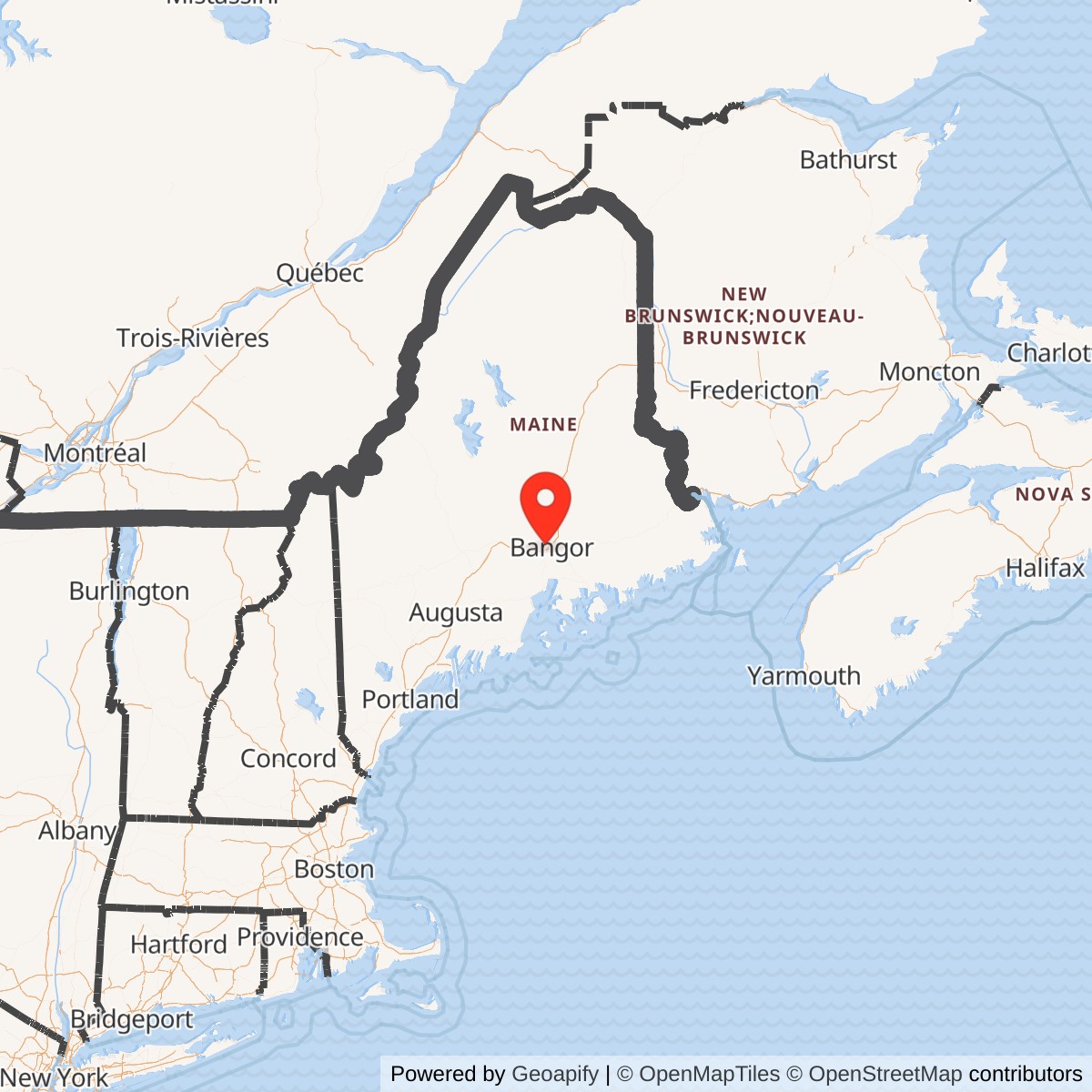
Longitude: -68.8281
Dow AFB had its beginning on August 19, 1923 when General "Billy" Mitchell landed with the entire Air Corps - 15 Martin bombers and 11 DeHavilland scout planes - on a strip of the F. F. Rich farm on Cooper Road.
Gen. Mitchell was quoted as saying, "I see a great future for Bangor as an air base. It is a natural air center and ideally suited as an airdrome." His words came true in September, 1954 when the United States Air Force declared Dow a permanent base.
From 1925 until 1940 the area was an airport owned by Edward R. Godfrey, who leased it to various flying services. Northeast Airlines, whose flights leave Dow daily, has been in operation here since 1933.
On August 15, 1940, construction began on a combined military and commercial, Class IV airport, with the agreement that Bangor would supply the land and the Federal government the funds.
During World War Two, Dow played a major role in the defense of the United States. The 43rd Bombardment Group, a unit of the Fifth Air Force, received its training at Dow and in February, 1942 left here to become the victors of such battles as the Coral Sea, Bismark Sea, New Guinea, Dutch East Indies, and the liberation of the Philippines.
The Eighth Air Force, which Dow is now an integral part, established the 332 Sub-depot here in 1942, using the base as a staging area and final check-up point for various fighter and bombardment groups.
The North Atlantic Wing of the Air Transport Command operated at Dow from 1941 until December 1945, ferrying tactical aircraft to all points of defense.
Among other operations of equal importance were: the anti-submarine patrols of the 92nd Reconnaissance Group, the State of Maine Aircraft School which trained hundreds of civilian personnel in electrical, mechanical and sheet metal specialties, the training of recruits, quartermaster troops and ordinance, signal and service units for combat groups, and the training of 5,000 highly specialized aviation engineers.
During 1942, Dow was under the control of the First Air Force, although all tactical aircraft arriving here were under the direct jurisdiction of the eighth Air Force and the ATC.
Some of the aircraft maintained at Dow during the war were B-17 Flying Fortresses, 3-24. Liberators, P-38 Lightings, A-29 Anti-submarine aircraft, B-25s, A-20s, C-47s, C-46s and C-45s.
A total of more than 18,700 fighters were ferried to and from the U.S. by the ATC at this Maine installation and nearly 100,000 combat crews en route to theaters of war or returning to the U.S. processed here, and millions of pounds of vitally needed cargo were flown by Dow planes.
At the end of the war until the arrival of the 14th Fighter Wing in 1946, Dow was placed on a stand-by status.
During the period the 14th was stationed here, they were credited with "ironing out" the bugs of Republic Aviation's first F-64 Thunderjets.
In October 1949 the 14th left Dow and in December of the same year the base was deactivated.
The Maine Air National Guard, which was stationed here since the war ended began using Dow as a training camp in December of 1950 and two months later, the 101st Fighter Interceptor Wing of the Maine ANG was called to active duty.
Dow was reactivated in April 1951 and almost immediately the 132nd Fighter Wing moved here. The 132nd was formerly the Nebraska-Iowa ANG group which was called to duty on the same day and was transferred to Dow from bases in Lincoln, Neb., Des Moines, Iowa, and Sioux City, Iowa.
At the time of the reactivation, Dow was under the command of the Strategic Air Command, but in January 1952, the 132nd Wing and the base was transferred to the Tactical Air Command.
In June of 1952 the 132nd Fighter-Bomber Wing was transferred from Dow to Alexandria AFB, Louisiana, and a month later Dow was reverted to the Strategic Air Command, while the base itself was under the command of the 4009th Air Base Group.
In January 1953, the base command changed again from the 4009th ABGp to the 506th Strategic Fighter Wing. The latter was placed in a training status and was assigned the Korean-tested F-84G Thunderjet.
During the latter part of 1953 the 506th Strat Wing performed a three-month TDy tour in Japan with its primary mission set as the defense of the northern part of that country.
On January 15th, 1954, the 506th became the first operational organization of the United States Air Force to receive the F-84P Thunderstreak, marking the second time a Dow unit "checked-out" first with a Republic jet aircraft.
In addition to the 506th Strat Wing, Dow was also the home of the 49th Fighter Interceptor Squadron, a unit of the Air Defense Command.
In March, 1955 the 4060th Air Refueling Wing officially replaced the 506th Strategic Fighter Wing, which transferred to Tinker AFB, Oklahoma.
Dow gives logistical support to the Deblois Bombing Range, Columbia Falls, Maine: the 907th AC & W Sq.. Bucks Harbor, Maine; Portsmouth AFB, Portsmouth, New Hampshire; and Plattsburg AFB, Plattsburg, New York, and the 765th Aircraft Control and Warning Sq. at Charleston; Maine.
Dow is also the home of the 101st Fighter Interceptor Wing of the Maine Air National Guard.