BOMARC (IM-99A,B)
Summary of the BOMARC ProgramDevelopment History
Site Configuration
Here's how the BOMARC worked
Site Locations
Cleanup after the BOMARC accident at McGuire AFB
BOMARC at McGuire AFB
BOMARC at Langley AFB
BOMARC at Niagara AFB
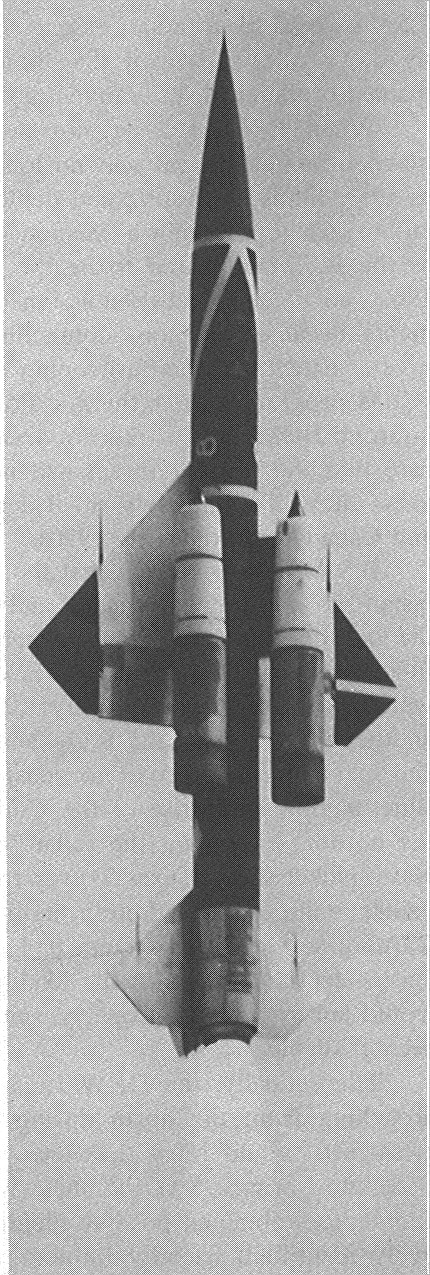
In the 1950s, the Air Force strove to create a composite air defense force. The philosophy of not relying on a single weapons system, such as manned aircraft, could be stated: "Analysis of any one weapon system will reveal weaknesses which could be exploited; however, it is extremely difficult to find any one specific weakness which is common to a composite weapon system." This conviction partly explains the Air Force attempts over a ten-year period to develop an unmanned interceptor to complement and supplement its other defensive weapons.
As early as 1945 the Army Air Forces (AAF) had asked Boeing to study prospects for developing a ground-to-air pilotless aircraft (GAPA). AAF interest in this concept began during World War II when Germany launched V-2 surface-to-surface liquid-fueled missiles against Britain. The V-2, with a range of only 300 miles, was not particularly accurate. It could, however, attain supersonic speeds, inviting prospects for similar, though more deadly, weapons in the postwar world.
Boeing's GAPA experiments envisioned a missile effective up to 35 miles. Although one test missile fired successfully and the Army and Navy were testing various other short-range surface-to-air missiles, the JCS decided to halt GAPA studies in 1949. The Air Force did not contest their decision; its concept of air defense called for striking an enemy bomber as far from its target as possible. Accordingly, Air Materiel Command asked Boeing to join with researchers at the University of Michigan's Air Research Center in January 1950 to examine the feasibility of building an accurate, long-range, supersonic missile for air defense. By June 1950 experts at Boeing and Michigan agreed that a missile could be developed to fly at speeds from Mach .09 to Mach 3 at a ceiling of 80,000 feet and with a range of 200 miles. The missile, to be called BOMARC ("BO" for Boeing and "MARC" for Michigan Air Research Center), was expected to become operational by 1956.
Many Air Force technical specialists doubted that the 1956 operational date for BOMARC could be met. Time proved them correct. The scientists' estimates proved too optimistic, and by the end of 1954 BOMARC's operational date had slipped to 1959. Strictly speaking, the Air Force achieved operational readiness in December 1959 when one missile was ready to be deployed at McGuire Air Force Base, New Jersey. This accomplishment came after seven years of testing and attempts to mate BOMARC with a nuclear warhead and integrate it into SAGE.
Overall, BOMARC proved a major disappointment for the Air Force. In the early 1950s, air defense commanders foresaw 4,800 missiles deployed at 40 sites in the continental United States. In actuality, fewer than 500 missiles deployed on 8 sites in the northeastern United States and on 2 sites in Canada. Testing did not end with the activation of the McGuire missile site; it continued until August 1963 when 215 missiles had been expended in tests that usually failed to meet standards. By the end of 1964, the inactivated BOMARC A was converted into a drone.
The improved BOMARC B finally achieved a measure of reliability. It could be equipped with a nuclear warhead and synchronized with SAGE. This was an air-breathing, rocket-boosted missile with a range exceeding 400 miles in its advanced versions and with a speed of Mach 2.5. Powered by a ramjet engine, BOMARC B was guided to its quarry by the SAGE system; it then homed in on the target by radar. It remained in the air defense inventory until 1972.
When BOMARC developed into an efficient system, the Soviet manned bomber threat was no longer a major public concern. As early as 1959, funds for testing and deployment were declining. Congressional enthusiasm for funding a weapon designed to defeat the bomber waned as the ICBM appeared to be the more dangerous threat. By the early 1960s, air defense had been assigned a low priority in Congress. Requirements became far more compelling for antimissile defense and, to a greater extent, for the burgeoning Atlas, Titan, and Minuteman offensive ICBM programs. After the Air Force achieved its goal in attempting to improve BOMARC, it did not want to deactivate the missile. It made a case that the bomber threat had not disappeared completely, and Congress allowed a relatively small deployment in the eastern United States and Canada until the early 1970s.